




When choosing a whole-house water filtration system, the filtration cartridges are only one part of the equation. The cabinet, plumbing connections, sealing components and internal construction also play an important role in the system’s overall design and reliability.
The ODIS Premium Whole Home Water Filtration System is designed as a three-stage point-of-entry solution, treating incoming water before it reaches taps, showers, laundry facilities and connected appliances.
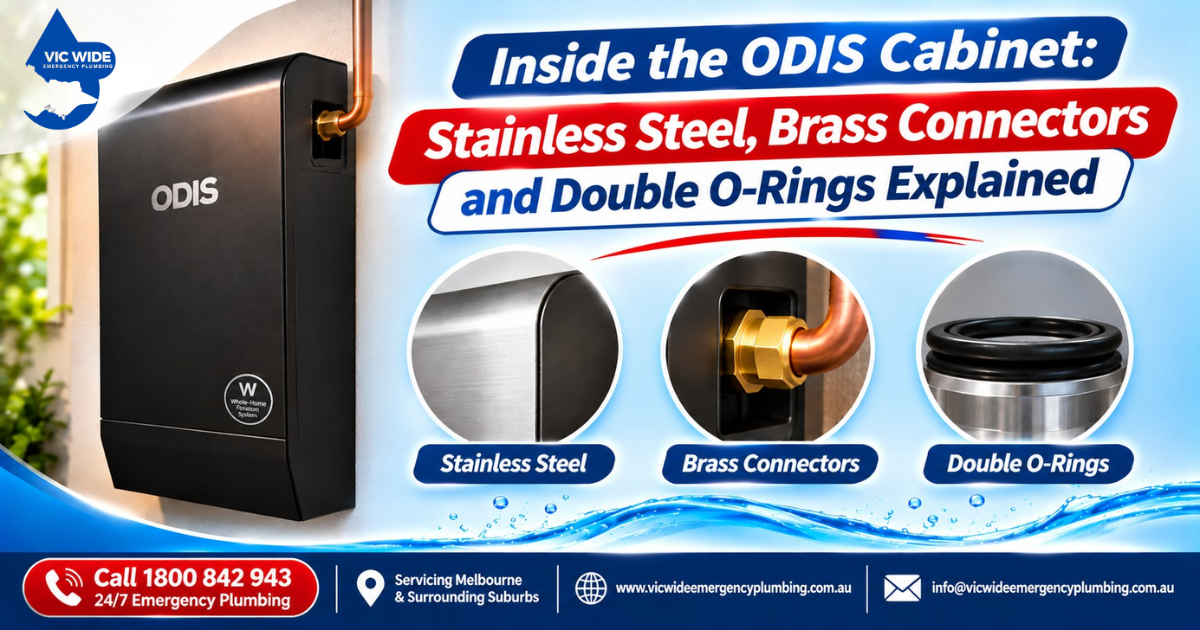
One of the interesting aspects of this system is its attention to construction details. From the stainless steel components and heavy-duty brass connectors to its double O-ring sealing arrangement, each feature has a specific purpose within the overall design.
In this guide, Vic Wide Emergency Plumbing takes a closer look inside the ODIS cabinet and explains what these components do and why they matter when considering a whole-house water filtration system.
What Is the ODIS Whole Home Water Filtration System?
The ODIS Premium system is a whole-house water filtration solution designed to connect to the main water supply entering a property.
Unlike an individual drinking-water filter installed beneath a kitchen sink, a point-of-entry system treats incoming water before it is distributed throughout the home’s plumbing network.
According to the product brochure, the ODIS system features:
- A three-stage point-of-entry filtration arrangement.
- A fully enclosed premium metal cabinet.
- Full-sized 20 x 4.5-inch filter housings.
- High-flow whole-home performance.
- Stainless steel construction components.
- Heavy-duty brass connectors.
- Double O-ring sealing components.
- An optional additional three-stage reverse osmosis system.
The enclosed cabinet provides a finished appearance while housing the filtration components and plumbing connections in one organised installation.
1. Stainless Steel Cabinet: Designed for Durability
The external construction of a filtration system is important because it houses and protects the equipment used for water treatment.
The ODIS Premium system features a fully enclosed metal cabinet with a stainless steel cover. This provides a durable external finish while helping protect the internal components.
Why Is Stainless Steel Used?
Stainless steel is commonly selected for plumbing and equipment applications because of its strength, durability and corrosion-resistant properties.
Some of its key characteristics include:
- Durable construction: Designed to withstand normal conditions associated with equipment installation and use.
- Corrosion resistance: Helps resist deterioration when the appropriate stainless steel grade is used.
- Easy-to-maintain surface: Provides a smooth external finish that can be cleaned.
- Modern appearance: Complements contemporary residential plumbing installations.
- Protective enclosure: Helps shield internal equipment from everyday external exposure.
The ODIS brochure also identifies a stainless steel frame and housing end plate, designed to provide additional support and reduce the risk of damage during filter changes.
For homeowners, these construction details are worth considering when comparing different whole-house filtration systems.
2. Brass Connectors: Supporting Strong Plumbing Connections
Connectors are essential parts of any water filtration installation. They provide the connection between the filtration equipment and the property’s plumbing network.
The ODIS system uses heavy-duty brass connectors designed to handle higher water pressure.
What Makes Brass Connectors Useful?
Brass is widely used in plumbing because of its strength, machinability and suitability for many water connection applications.
The ODIS brochure highlights several benefits of its brass connector design:
- Heavy-duty construction.
- Designed to handle higher water pressure.
- More resistant to cracking than plastic connectors.
- Anti-corrosion properties intended to help prevent secondary contamination.
Why Do Plumbing Connections Matter?
Even a well-designed filtration cabinet needs secure plumbing connections to operate properly.
Poorly fitted or unsuitable connectors can contribute to leaks, pressure-related problems and maintenance difficulties.
Using appropriate connectors, together with correct installation practices, helps create a dependable connection between the filtration system and the home’s water supply.
3. Double O-Rings: An Additional Layer of Leak Protection
One of the notable design features inside the ODIS system is its double O-ring arrangement.
An O-ring is a circular sealing component usually made from an elastomeric material. It sits between connecting surfaces to help prevent water from escaping through small gaps.
The ODIS brochure describes its double O-ring arrangement as an additional sealing measure.
How Do Double O-Rings Work?
A single O-ring creates a seal between two connected components. A double O-ring arrangement uses two sealing points to provide an additional layer of protection.
The main purposes include:
- Helping prevent water leaks.
- Providing an additional sealing barrier.
- Supporting connection security.
- Helping reduce the possibility of water escaping from connection points.
Why Is This Feature Important?
Water filtration systems operate as part of a pressurised plumbing network. Even a small leak around a connection can lead to water wastage and potential damage if it goes unnoticed.
A properly designed sealing arrangement can help reduce this risk.
However, O-rings still need to be inspected and maintained. Incorrect installation, damaged seals, wear or unsuitable replacement components can affect sealing performance.
4. Stainless Steel and Glass Pressure Gauge
Monitoring pressure is another important consideration when installing a whole-house filtration system.
The ODIS system includes a stainless steel and glass gauge, designed with UV protection and anti-corrosion features according to its product brochure.
Why Is a Pressure Gauge Useful?
A pressure gauge provides a reading of the water pressure at the point where it is installed.
This information can help with:
- Monitoring system operating pressure.
- Identifying unusual pressure changes.
- Supporting routine inspection and servicing.
- Assessing potential pressure-related issues.
Pressure readings should be interpreted according to the manufacturer’s operating specifications and the property’s plumbing requirements.
5. Full-Sized 20 x 4.5-Inch Filter Housings
The ODIS system uses full-sized 20 x 4.5-inch filter housings.
The brochure describes these as genuine full-sized housings with a double water-contact surface intended to support filtration performance.
Why Does Filter Housing Size Matter?
Filter housing dimensions influence the types of cartridges that can be accommodated and the overall filtration configuration.
Full-sized housings can provide room for larger filter cartridges and support the system’s intended whole-house flow requirements.
The brochure also highlights the flexibility to choose filter suppliers through standard filter fittings.
When comparing systems, it is worth checking cartridge compatibility, replacement availability, filtration specifications and ongoing maintenance costs.
6. Three-Stage Filtration: What’s Inside?
The ODIS system uses a three-stage filtration arrangement designed to treat incoming water through different filtration media.
The product brochure identifies the following filtration components:
Stage 1: Sediment Filtration
The sediment filter uses a three-layer technology and is described as capable of filtration down to 1 micron.
Its purpose is to capture suspended particles and sediment in the incoming water.
Depending on water conditions, sediment filtration may help reduce:
- Dirt and suspended particles.
- Sand and other visible impurities.
- Rust particles.
- Other particulate matter.
A sediment filter also helps protect the later filtration stages from excessive particle loading.
Stage 2: Heavy Metal Reduction and Taste Improvement Carbon Filter
The brochure identifies a KDF 55-based filtration stage intended to reduce selected heavy metals and provide antibacterial properties.
It also describes the use of natural coconut carbon to improve water taste and quality.
The effectiveness of this stage depends on the actual water conditions, media configuration and product-specific performance testing.
Stage 3: Limescale Reduction and Taste Improvement Carbon Filter
The third stage uses a combination of limescale-reduction media and natural coconut carbon.
According to the brochure, this stage is designed to:
- Support limescale reduction.
- Improve water taste.
- Provide filtration down to 1 micron.
- Help extend the filtration media’s service life.
Actual limescale reduction depends on the water chemistry and the performance of the specific media. It should not automatically be considered equivalent to a conventional water softener.
7. Optional Three-Stage Reverse Osmosis System
For households looking for an additional level of drinking-water treatment, the ODIS brochure also identifies an optional three-stage reverse osmosis system.
Reverse osmosis uses a specialised membrane to reduce many dissolved substances from water.
The performance of an RO system depends on its membrane, configuration, operating conditions and maintenance.
The brochure recommends using the whole-home three-stage system in conjunction with an under-bench ODIS reverse osmosis system for a long-term PFAS protection approach.
Homeowners should review the specific product testing and performance information before relying on any system for PFAS reduction. No filtration system should be assumed to remove every PFAS compound.
8. Why Does Cabinet Construction Matter When Choosing a Water Filter?
When comparing whole-house filtration systems, it is easy to concentrate only on the number of filtration stages.
However, the overall construction also deserves attention.
A well-designed system should consider:
- The strength and material of the external cabinet.
- The quality and suitability of plumbing connectors.
- The sealing arrangement around connections.
- Pressure monitoring facilities.
- Filter housing dimensions.
- Cartridge replacement access.
- Availability of replacement components.
- Maintenance and servicing requirements.
These features can influence installation, ongoing maintenance and the practical experience of owning a filtration system.
9. Why Professional Installation and Maintenance Matter
Even a premium filtration system needs correct installation and routine servicing.
A whole-house filtration unit connects directly to the property’s incoming water supply. Its installation should take into account water pressure, available space, plumbing connections and the manufacturer’s specifications.
Professional installation can help ensure that:
- The system is connected correctly.
- Plumbing connections are appropriately sealed.
- The unit is positioned for maintenance access.
- Water flow and operating pressure are considered.
- Filter cartridges can be replaced when required.
Regular maintenance should include checking for leaks, inspecting O-rings, monitoring pressure and replacing filtration cartridges according to the manufacturer’s recommendations.
Final Thoughts
The internal construction of a whole-house water filtration system can be just as important as the filtration technology itself.
The ODIS Premium system brings together a fully enclosed metal cabinet, stainless steel components, heavy-duty brass connectors, double O-ring seals and a three-stage filtration arrangement.
Each component has a particular role, from supporting the plumbing connections and helping prevent leaks to housing the filtration cartridges and monitoring operating pressure.
For Melbourne homeowners considering a whole-house water filtration installation, understanding these features can make it easier to compare systems and identify the right solution for their property.
Vic Wide Emergency Plumbing can help you explore suitable plumbing and water filtration installation options for your home.
Frequently Asked Questions
1. What is the ODIS whole-house water filtration system?
ODIS is a three-stage point-of-entry water filtration system designed to treat incoming water before it reaches taps, showers, laundry facilities and connected appliances.
2. Why does the ODIS system use a stainless steel cabinet?
The stainless steel cover and metal cabinet provide an enclosed, durable housing for the filtration equipment and plumbing components.
3. What is the purpose of brass connectors?
Brass connectors provide plumbing connections between the filtration system and the water supply. The ODIS brochure describes them as heavy-duty connectors designed to handle higher water pressure.
4. What are double O-rings?
Double O-rings are two sealing components used at a connection point to provide an additional sealing barrier and help reduce the risk of water leaks.
5. What happens if an O-ring becomes damaged?
A damaged or worn O-ring can affect the seal and potentially cause leakage. It should be inspected and replaced with a compatible component when necessary.
6. What size filter housings does the ODIS system use?
The ODIS brochure identifies full-sized 20 x 4.5-inch filter housings.
7. How many filtration stages does the ODIS system have?
The ODIS Premium whole-home system uses three filtration stages, including sediment filtration and two carbon-based filtration stages.
8. Does the ODIS system include a pressure gauge?
Yes. The brochure identifies a stainless steel and glass gauge with UV protection and anti-corrosion features.
9. Can the ODIS system reduce limescale?
Its third filtration stage includes limescale-reduction media. Actual performance depends on the incoming water chemistry and the specific media configuration.
10. Is reverse osmosis available with the ODIS system?
Yes. The brochure lists an optional additional three-stage reverse osmosis system for drinking-water treatment.
11. Does the ODIS system provide PFAS protection?
The brochure recommends combining the whole-home three-stage system with an under-bench ODIS reverse osmosis system for a long-term PFAS protection approach. Homeowners should check product-specific testing and performance information for the PFAS compounds of concern.
12. How often should ODIS filter cartridges be replaced?
Replacement intervals depend on water quality, usage and the manufacturer’s recommendations. Regular inspection and timely cartridge replacement are important for maintaining filtration performance.
Contact Vic Wide Emergency Plumbing
Thinking about installing a whole-house water filtration system at your Melbourne property?
Speak with Vic Wide Emergency Plumbing about your plumbing and filtration installation requirements.
Phone: 1800 842 943
Email: info@vicwideemergencyplumbing.com.au
Website: https://www.vicwideemergencyplumbing.com.au/
Servicing Melbourne and surrounding suburbs, with 24/7 emergency plumbing support.
-
 November Nov 2026Who Pays for Plumbing Repairs in a Victorian Rental? Landlord or Tenant?
Plumbing problems can happen in any rental property. A leaking tap, blocked drain, burst pipe or broken hot water system can quickly become stressful for both tenants and landlords. But when a repair is needed, one important question often comes up: who is responsible for paying? In Victoria, rental repair responsibilities are generally determined by […]
Read More -
 November Nov 2026Boiling Water vs Filtering Water: What’s the Difference?
Clean drinking water is essential for everyday life. Whether you are preparing tea, cooking meals or filling a glass from the kitchen tap, you want water that is suitable for drinking and tastes fresh. Two common ways of treating drinking water at home are boiling and filtration. Although both methods can improve certain aspects of […]
Read More -
 November Nov 2026PFAS in Melbourne Water, What They Are and How Water Filters Can Fix It
Water quality is an important concern for Australian households, and PFAS contamination has received increasing attention in recent years. Many Melbourne homeowners are now asking what PFAS chemicals are, how they can enter drinking water and whether household filtration systems can help reduce them. PFAS stands for per- and polyfluoroalkyl substances. These are a large […]
Read More