




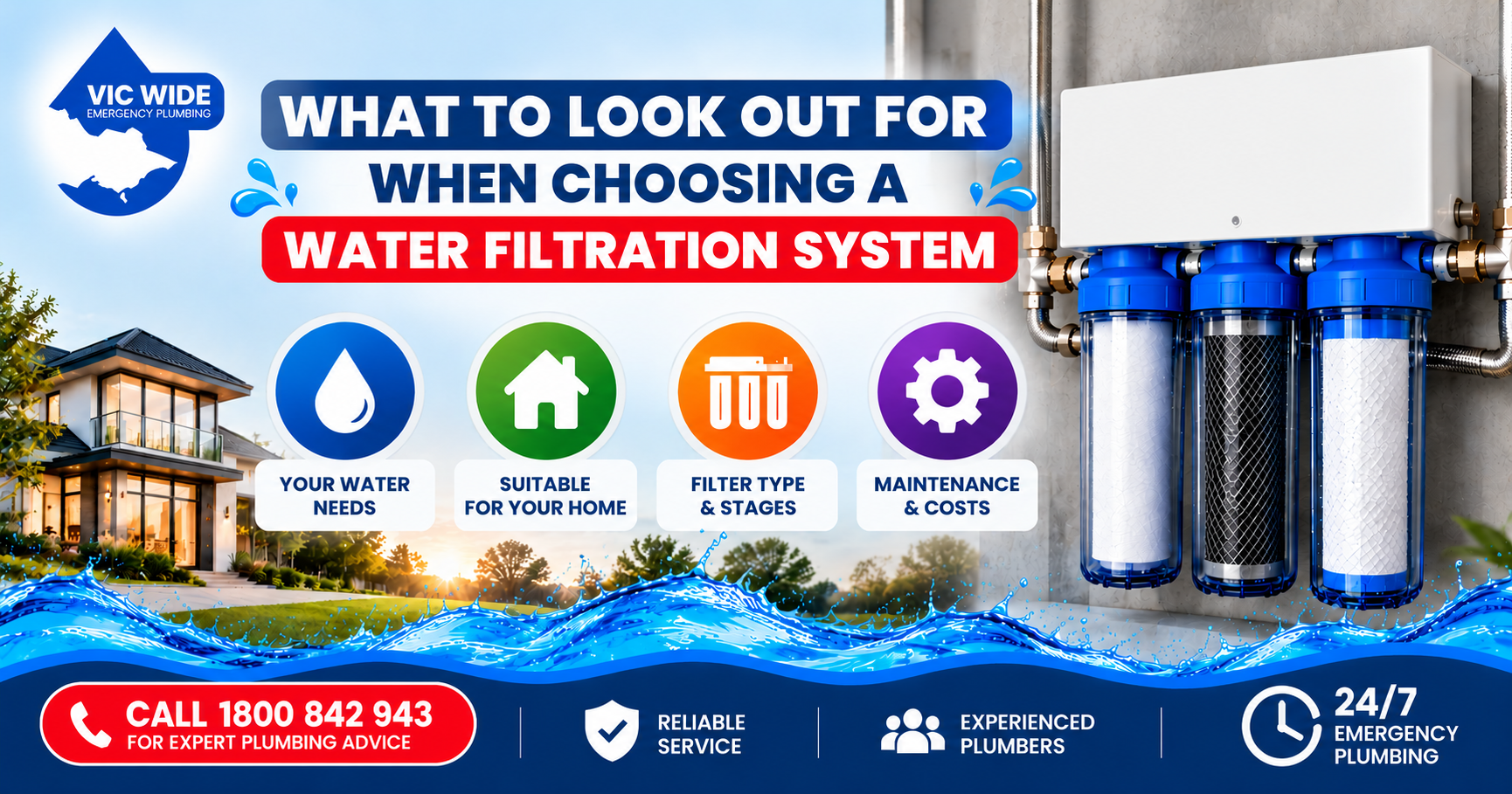
Choosing a water filtration system for your home is an important decision. You want a system that suits your household’s needs, addresses your water-quality concerns and offers reliable performance over time.
With so many products available, researching the right option can quickly become confusing. Comparison websites, product reviews and online recommendations can help you understand your choices, but not all information is presented from the same perspective.
Some reviews are based on technical specifications and independent testing, while others may be influenced by the commercial interests of the business publishing them.
So, how can you tell whether a water filtration review is trustworthy? In this guide, Vic Wide Emergency Plumbing explains what to look for when comparing filtration systems and how to make a more informed decision for your Melbourne home.
1. Find Out Who Published the Review
Before relying on a product comparison, take a moment to identify the organisation or business behind it.
Is the review published by an independent testing organisation, a filtration specialist, a retailer or a plumbing company that installs its own preferred systems?
Understanding who created the content can help you assess the information more carefully.
A website may present its findings as an impartial comparison while also having a commercial interest in the products being discussed. This does not automatically mean its information is inaccurate, but it is worth considering when evaluating its conclusions.
Check the Company’s Business Interests
Look at the products and services offered by the publisher.
For example, does the company:
- Sell its own water filtration systems?
- Install or maintain competing products?
- Sell replacement cartridges or filtration accessories?
- Recommend particular brands as part of its services?
These details can help you understand the perspective behind the review and whether the publisher might benefit from recommending one system over another.
2. Understand How Commercial Interests Can Influence Comparisons
Businesses naturally want customers to choose their products or services. However, commercial interests can influence which features are highlighted, which drawbacks receive attention and how products are ranked.
For example, a comparison website might describe a filtration system that uses manufacturer-approved replacement cartridges as restrictive because customers have fewer third-party options.
However, there may be reasons for this design choice. Using specified replacement cartridges can help maintain compatibility with the system and make it easier to follow the manufacturer’s maintenance requirements.
On the other hand, replacement flexibility may be an important consideration for some homeowners.
Rather than automatically treating a feature as an advantage or disadvantage, consider why the manufacturer has chosen that design and whether it suits your needs.
The same principle applies to other product characteristics. A fair comparison should explain the relevant benefits, limitations and trade-offs rather than relying on negative wording alone.
3. Verify Claims About Filtration Performance
Water filtration systems use different technologies to target different contaminants. As a result, performance claims should be supported by evidence relevant to the particular product and filter configuration.
When reading a review, look for supporting information about:
- Filtration performance
- Product specifications
- Applicable certifications
- Cartridge replacement requirements
- Warranty conditions
- Installation and operating requirements
If a website claims that one system performs better than another, check how that conclusion was reached.
Was the comparison based on manufacturer documentation, independent laboratory testing, published certification information or the reviewer’s own opinion?
Independent testing can be particularly useful when it clearly identifies the product tested, the testing method, the applicable standard and the specific contaminant assessed.
Remember that a filter designed to reduce chlorine, for example, should not automatically be assumed to remove bacteria, viruses, dissolved salts or every heavy metal.
4. Look Beyond the Headline Claims
A product comparison may contain technically correct information without providing the full context needed to make a decision.
One website might focus heavily on the disadvantages of a particular feature while overlooking why that feature exists. Another might emphasise its preferred product’s strengths without discussing its limitations.
When comparing systems, ask yourself:
- Are the advantages and disadvantages explained fairly?
- Are similar features assessed using the same criteria?
- Are important maintenance requirements discussed?
- Are the limitations of each system clearly explained?
- Is there evidence to support the conclusions?
Pay attention to what is missing as well as what is included. A useful review should help you understand the product, not simply persuade you to choose a particular brand.
5. Be Careful With Product Ratings and Rankings
Online ratings can make a recommendation appear more scientific or objective than it really is.
If one water filtration system is ranked above another, check the methodology behind the result.
Consider the following questions:
- What criteria were used to score each product?
- Were the same criteria applied to every system?
- How were the individual scores weighted?
- Were the results supported by testing or documentation?
- Does the publisher have a commercial relationship with any of the brands?
A transparent ranking can be useful when its methodology is clearly explained and consistently applied.
Without this information, it can be difficult to determine whether the ranking reflects genuine product performance, the reviewer’s preferences or the criteria chosen for the comparison.
6. Read Negative Reviews With the Same Care as Positive Ones
Negative claims about competing products deserve careful consideration, particularly when they involve cost, maintenance, reliability or filtration performance.
If a review describes a system as expensive, restrictive, difficult to maintain or inferior, look for the evidence supporting that statement.
Customer reviews can provide useful information about real-world experiences, but individual experiences may not represent the performance of every installation. Look for recurring patterns across multiple reviews and consider whether the circumstances are relevant to your own home.
Also pay attention to the language used. Terms such as “lock-in”, “poor quality” or “inferior” can influence your perception before the facts have been explained.
A credible review should provide enough information for you to reach your own conclusion.
7. Check the Original Sources
A claim does not become reliable simply because it appears on several websites.
Multiple articles may repeat information from the same original review without independently checking it. As a result, a claim can appear widely accepted even when its supporting evidence is limited.
Whenever possible, follow the information back to its original source.
Useful sources may include:
- The manufacturer’s official product specifications
- Technical documentation and installation manuals
- Relevant certification records
- Independent laboratory test reports
- Warranty and maintenance documentation
- Customer feedback from multiple sources
If a comparison makes a specific claim but does not identify its source, consider treating it cautiously until you can verify it.
8. Review Certifications and Testing Information
Certifications can help you understand whether a product or component has been assessed against a particular standard. However, it is important to check exactly what the certification covers.
Before relying on a certification claim, establish:
What was certified? The certification may apply to an individual component, a filter cartridge or the complete system.
Which standard applies? Different standards address different product characteristics and performance requirements.
What does the certification demonstrate? A certification does not necessarily confirm that a product removes every contaminant or performs every function advertised.
Can the information be verified? Where possible, check the certification through the relevant certifying organisation rather than relying only on a logo displayed on a website.
The same approach applies to performance claims. Look for evidence that relates to the actual model and the specific water-quality concern you want to address.
9. Compare the Total Cost of Ownership
The initial purchase price is only one part of the cost of a water filtration system.
Before making a decision, consider the ongoing expenses and practical requirements associated with owning and maintaining it.
These may include:
- Replacement filter cartridges
- Recommended servicing intervals
- Installation costs
- Availability of compatible replacement parts
- Warranty coverage
- Any additional maintenance requirements
A system with a lower upfront price may have different ongoing costs from a more expensive alternative. Similarly, a system with manufacturer-specified replacement filters may offer predictable compatibility, while another may provide a wider range of replacement options.
Neither arrangement is automatically better for every household. Compare the full costs, maintenance requirements and product specifications before deciding.
10. Choose a System That Suits Your Home
The most suitable filtration system depends on your household’s water-quality concerns, water usage, plumbing arrangements and maintenance preferences.
Before choosing a system, consider these practical factors.
Your Water-Quality Concerns
Identify what you want the system to address, such as sediment, chlorine, taste or odour. If you are concerned about a particular contaminant, look for verified performance data for that substance.
Household Water Demand
A whole-house system needs to suit the expected water flow throughout your property. The number of occupants and the number of outlets used simultaneously can influence the system’s requirements.
Filter Type and Configuration
Different filtration technologies perform different functions. Review the type of media used, the specifications of the cartridges and the contaminants the system has been tested to reduce.
Water Pressure and Flow Rate
Check the manufacturer’s recommended operating pressure and flow requirements. The suitability of a system can depend on the existing plumbing and incoming water supply.
Maintenance and Replacement
Understand how frequently cartridges need to be replaced, where replacement filters can be obtained and whether the system requires regular servicing.
Installation Requirements
Consider where the system will be installed and whether the existing plumbing is suitable. Where regulated plumbing work is required in Victoria, it must be carried out by an appropriately licensed or registered plumbing professional.
How Vic Wide Emergency Plumbing Can Help
Choosing a filtration system involves more than comparing prices or relying on a single online review. Understanding the product specifications, installation requirements and maintenance needs can help you make a decision that suits your property.
Vic Wide Emergency Plumbing assists homeowners across Melbourne and surrounding suburbs with plumbing services and advice about their plumbing requirements.
If you are considering a water filtration installation, our team can help you discuss the plumbing aspects of your project and identify the next steps.
The right system should be selected according to your household’s needs and the manufacturer’s verified specifications, rather than marketing claims alone.
Frequently Asked Questions
1. What should I check before buying a water filtration system?
Consider your water-quality concerns, the filtration technology, verified performance claims, installation requirements, water flow, maintenance schedule, replacement cartridge costs and warranty conditions.
2. Can I trust online water filtration comparisons?
Comparisons can be useful, but check who published them, whether the publisher has a commercial interest and how the products were assessed. Verify important claims through manufacturer documentation and independent testing where available.
3. Why does the publisher of a product review matter?
The publisher may sell, install or maintain one of the products being compared. Understanding these relationships can help you assess whether the review presents the information fairly and transparently.
4. Are higher-rated filtration systems always better?
Not necessarily. Ratings depend on the criteria and scoring method used. A higher score does not automatically mean a system is better suited to your household or more effective against the contaminants you want to reduce.
5. How can I verify a water filtration system’s claims?
Review the manufacturer’s technical specifications, relevant certification records and independent test reports. Check which model was assessed, which standard was used and what the results actually demonstrate.
6. Does every water filtration system remove the same contaminants?
No. Different filter types target different substances. Check the system’s verified performance for the particular contaminants you want to reduce rather than assuming all filtration systems provide the same treatment.
7. Should I consider replacement filter costs before buying?
Yes. Replacement cartridges and servicing can contribute significantly to the long-term cost of ownership. Check the recommended replacement intervals, cartridge prices and availability before purchasing a system.
8. Do I need a plumber to install a whole-house filtration system in Victoria?
It depends on the equipment and the plumbing work involved. Where the installation includes regulated plumbing work, an appropriately licensed or registered plumbing professional must carry it out.
9. Can Vic Wide Emergency Plumbing help with water filtration installation?
Vic Wide Emergency Plumbing can help you discuss your plumbing requirements and the next steps for a filtration installation. Contact the team to enquire about the work required at your property.
Conclusion
Choosing a water filtration system is an important decision, and reliable research can make the process easier.
Look beyond headlines, rankings and strong opinions. Check who published the information, investigate commercial interests, verify technical claims and compare the ongoing costs and maintenance requirements of different systems.
Most importantly, choose a filtration system based on your household’s needs, the product’s verified capabilities and suitable installation requirements.
If you need help discussing your plumbing needs or a potential water filtration installation in Melbourne, Vic Wide Emergency Plumbing is here to help.
Contact Vic Wide Emergency Plumbing
Need plumbing advice or want to discuss a water filtration installation?
Vic Wide Emergency Plumbing
- Phone: 1800 842 943
- Email: info@vicwideemergencyplumbing.com.au
- Website: https://www.vicwideemergencyplumbing.com.au/
- Service area: Melbourne and surrounding suburbs
- Emergency plumbing: Available 24/7
Contact our team to discuss your plumbing requirements.
-
 November Nov 2026PFAS in Melbourne Water, What They Are and How Water Filters Can Fix It
Water quality is an important concern for Australian households, and PFAS contamination has received increasing attention in recent years. Many Melbourne homeowners are now asking what PFAS chemicals are, how they can enter drinking water and whether household filtration systems can help reduce them. PFAS stands for per- and polyfluoroalkyl substances. These are a large […]
Read More -
 November Nov 2026Do Whole House Water Filters Increase Home Value?
When homeowners consider ways to improve their property, they often think about kitchen renovations, solar panels, energy-efficient appliances and bathroom upgrades. However, one improvement that is gaining attention is a whole house water filtration system. A whole house water filter can improve the quality of water supplied throughout a property, support household plumbing and make […]
Read More -
 November Nov 2026What Happens If You Drink Unfiltered Tap Water Every Day?
Water is an essential part of everyday life. Whether you are drinking a glass of water, preparing meals, making tea or coffee, or filling a bottle before leaving home, you probably use tap water several times a day. But have you ever wondered what is actually present in the water coming from your kitchen tap? […]
Read More