




Water is something we use every day, from drinking and cooking to showering, washing clothes and cleaning. While the water supplied to your property may meet applicable drinking water standards, its quality and characteristics can still vary depending on your location, plumbing condition and water source.
Unusual tastes, unpleasant smells, visible particles and mineral deposits can sometimes indicate that your household water needs further investigation. A suitable water filtration system may help address specific water-quality concerns and provide an additional level of treatment throughout your home.
But how do you know when it is time to consider installing one?
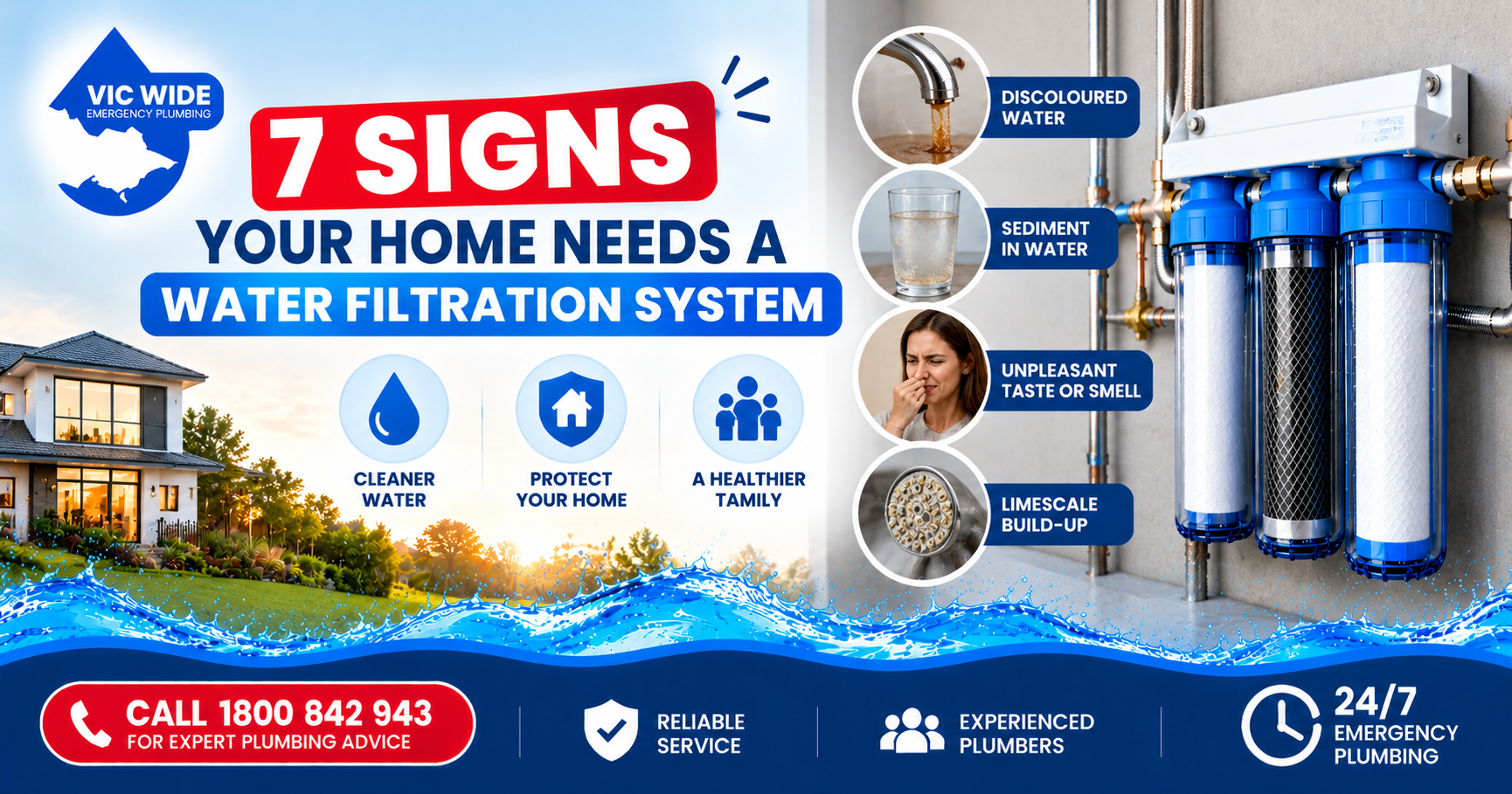
In this guide, Vic Wide Emergency Plumbing explores seven common signs that may indicate your home could benefit from a water filtration system, along with what homeowners should consider before choosing one.
1. Your Tap Water Has an Unpleasant Taste
One of the first things homeowners notice is a change in the taste of their tap water.
Water that tastes strongly of chlorine, metal or other unusual flavours may indicate the presence of substances affecting its taste. Chlorine is commonly used during water treatment, but some people find its taste or smell unpleasant.
Older plumbing fixtures or pipes may also contribute to changes in water characteristics.
A suitable carbon filtration system may help reduce chlorine and certain taste-related compounds, depending on the filter’s specifications.
If the taste changes suddenly or becomes unusually strong, investigate the cause rather than assuming a filter will solve the problem.
2. Your Water Has an Unusual Smell
Clean household water should not have a persistent unpleasant smell. If you notice a chlorine-like, metallic, earthy or rotten-egg odour, it may be worth investigating your water supply.
Different smells can have different causes:
- Chlorine-like smell: May be associated with disinfectants used in water treatment.
- Rotten-egg smell: Can be associated with hydrogen sulphide or plumbing-related issues.
- Metallic smell: May be linked to corrosion or contact with metal plumbing components.
- Earthy or musty smell: May be associated with organic material or other water-quality issues.
A filtration system designed for the specific issue may help improve water quality. However, persistent or sudden changes in smell should be investigated to identify the underlying cause.
3. You Notice Sediment or Particles in Your Water
Have you ever noticed small particles, rust-coloured water or visible sediment coming from your tap?
These signs may indicate suspended materials entering the water supply or particles coming from the property’s plumbing.
Common examples include:
- Sand or fine grit.
- Rust particles.
- Dirt and suspended sediment.
- Small visible deposits in collected water.
A sediment filtration system is designed to capture certain suspended particles before water reaches connected fixtures.
If discoloured water or particles appear regularly, it is important to investigate the source. Corroded pipes, plumbing repairs or supply-related issues may require attention before selecting a filtration solution.
4. Limescale and Mineral Deposits Keep Appearing
White, chalky deposits around taps, showerheads, kettles and other water-using appliances may be signs of hard water.
Hard water contains higher concentrations of dissolved minerals, particularly calcium and magnesium. When water evaporates, these minerals can leave behind visible deposits.
Over time, mineral build-up may affect:
- Showerheads and tap outlets.
- Kettles and hot water appliances.
- Washing machines and dishwashers.
- Plumbing fixtures and fittings.
It is important to understand that ordinary sediment and carbon filters do not necessarily remove dissolved hardness minerals.
If hard water is the concern, a water softener or a suitable scale-control treatment may be more appropriate. The right option depends on the water characteristics and the problem you want to address.
5. Your Skin and Hair Feel Different After Showering
Some homeowners notice that their skin feels dry or their hair feels different after showering.
Water characteristics, including hardness and chlorine levels, may contribute to these experiences for some people. However, skin and hair changes can have several causes, including personal care products, environmental conditions and individual sensitivities.
A filtration system designed to reduce certain substances may help address specific water-quality concerns.
Before investing in a whole house filtration system, consider having the water assessed to identify whether filtration, softening or another treatment option is suitable.
6. Your Appliances and Plumbing Fixtures Develop Frequent Build-Up
If you regularly clean mineral deposits from your taps, shower screens, kettles and other appliances, your household water may contain elevated levels of dissolved minerals.
Mineral deposits can accumulate over time and may contribute to reduced performance in some water-using appliances.
Look out for:
- White deposits around tap openings.
- Scale collecting inside kettles.
- Build-up around showerheads.
- Deposits on bathroom and kitchen fixtures.
- Reduced flow from outlets affected by mineral accumulation.
A suitable water treatment solution may help manage the underlying issue. However, the correct approach depends on whether the problem is caused by dissolved minerals, sediment or another factor.
7. You Are Concerned About the Quality of Your Household Water
Even when water looks clear, it does not necessarily mean that it is free from every unwanted substance.
Homeowners may consider water filtration because they want to understand what is present in their water and whether additional treatment is appropriate.
Depending on the water source and filtration technology, a system may be designed to reduce specific contaminants, including certain chemicals, sediment or selected heavy metals.
If you rely on rainwater tanks, bore water or another private water source, regular water testing is particularly important. The appropriate treatment system should be selected based on the results rather than general product claims.
Which Water Filtration System Is Right for Your Home?
Not every household needs the same filtration system. Different technologies are designed to address different water-quality concerns.
Here are some common options to understand before making a decision.
1. Whole House Water Filtration System
A whole house filtration system is generally installed on the main incoming water supply. This allows water to pass through the filtration unit before being distributed to connected taps, showers and appliances.
Depending on the system, it may help reduce sediment, chlorine, odours and other specified substances.
2. Under-Sink Water Filter
An under-sink filtration system is installed beneath a kitchen sink and supplies filtered water to a designated drinking water tap.
It can be a practical option for households mainly concerned about drinking and cooking water.
3. Multi-Stage Water Filtration System
A multi-stage filtration system uses different filter media to target different types of unwanted substances.
For example, a system may combine sediment filtration with granular activated carbon and carbon block stages.
The actual filtration capabilities depend on the media, product specifications and verified performance claims.
4. Reverse Osmosis System
Reverse osmosis systems use a specialised membrane to reduce a range of dissolved substances, depending on the system design.
They are commonly used for drinking water applications and may require additional components, including a storage tank or drainage connection.
5. Water Softener
If your main concern is hard water and mineral scale, a water softener may be worth considering.
Water softeners are designed to address hardness minerals and are different from standard sediment or carbon filtration systems.
What Should You Consider Before Installing a Water Filter?
Before purchasing a filtration system, it is important to understand your household’s requirements.
Consider the following factors:
Water quality: Identify the specific substances or issues you want to address. Testing can help determine which treatment is appropriate.
Household water usage: Consider the number of people living in your home and how many bathrooms and water outlets are connected.
Flow rate: The system should be capable of handling your household’s water demand without creating unnecessary restrictions.
Installation location: Whole house systems are commonly installed near the main incoming water supply, with enough space for connections and servicing.
Filter replacement: Check how frequently cartridges need to be replaced and whether compatible replacement filters are readily available.
Product certifications: Look for independent testing or certification relevant to the specific contaminants the product claims to reduce.
Ongoing costs: Consider cartridge replacements, servicing, installation and any additional components required.
Choosing a filtration system based on your actual water-quality needs is generally more effective than selecting one based only on price or marketing claims.
Why Professional Water Filter Installation Matters
Installing a whole house water filtration system involves more than connecting a filter to a pipe. The incoming water supply, existing plumbing, operating pressure and system capacity all need to be considered.
Incorrect installation may result in leaks, poor connections or restricted water flow.
Professional plumbing assistance can help with:
- Assessing the incoming water supply.
- Identifying a suitable installation location.
- Checking pipe sizes and connection compatibility.
- Installing appropriate plumbing fittings and isolation valves.
- Checking water pressure and flow requirements.
- Testing connections for leaks after installation.
A properly planned installation can also make future cartridge replacements and maintenance easier.
Final Thoughts
Changes in water taste, unpleasant smells, visible sediment, limescale deposits and frequent mineral build-up can all be reasons to investigate your household water quality.
A suitable water filtration system may help address specific concerns, but the right solution depends on what is actually present in your water. Not every filtration system removes every contaminant, so understanding your requirements before installation is important.
If you are considering a whole house water filtration system or need assistance with related plumbing work, Vic Wide Emergency Plumbing can help you arrange professional plumbing support in Melbourne.
Frequently Asked Questions
1. How do I know if my house needs a water filtration system?
Unpleasant tastes, unusual smells, visible sediment and recurring mineral deposits may indicate that your water quality needs further investigation. Water testing can help determine whether filtration is necessary.
2. Does a whole house water filter improve water quality at every tap?
A whole house system installed on the main incoming water supply can treat water distributed to multiple connected fixtures. Its performance depends on the filtration technology and installation arrangement.
3. Can a water filtration system remove chlorine?
Some carbon filtration systems are designed to reduce chlorine. Check the product’s specifications and independent performance testing to confirm its capabilities.
4. Does a water filter remove limescale?
Standard sediment and carbon filters do not generally remove dissolved hardness minerals. A water softener or suitable scale-control system may be more appropriate for managing limescale.
5. How often should water filter cartridges be replaced?
Replacement intervals depend on the filter type, water quality, household usage and manufacturer’s recommendations. Always follow the specified maintenance schedule.
6. Is a whole house water filter better than an under-sink filter?
It depends on your requirements. A whole house system treats water supplied to multiple connected outlets, while an under-sink filter generally treats water at one designated location.
7. Can I install a whole house water filter myself?
Some products are designed for simple installation, but connecting a system to the main water supply may involve fixed plumbing modifications. Professional assistance is recommended where plumbing alterations are required.
Contact Vic Wide Emergency Plumbing
Looking for professional plumbing assistance in Melbourne?
Vic Wide Emergency Plumbing provides plumbing services across Melbourne and surrounding suburbs, with emergency plumbing assistance available 24/7.
- Phone: 1800 842 943
- Email: info@vicwideemergencyplumbing.com.au
- Website: https://www.vicwideemergencyplumbing.com.au/
Contact Vic Wide Emergency Plumbing to discuss your plumbing requirements.
-
 November Nov 2026PFAS in Melbourne Water, What They Are and How Water Filters Can Fix It
Water quality is an important concern for Australian households, and PFAS contamination has received increasing attention in recent years. Many Melbourne homeowners are now asking what PFAS chemicals are, how they can enter drinking water and whether household filtration systems can help reduce them. PFAS stands for per- and polyfluoroalkyl substances. These are a large […]
Read More -
 November Nov 2026Do Whole House Water Filters Increase Home Value?
When homeowners consider ways to improve their property, they often think about kitchen renovations, solar panels, energy-efficient appliances and bathroom upgrades. However, one improvement that is gaining attention is a whole house water filtration system. A whole house water filter can improve the quality of water supplied throughout a property, support household plumbing and make […]
Read More -
 November Nov 2026What Happens If You Drink Unfiltered Tap Water Every Day?
Water is an essential part of everyday life. Whether you are drinking a glass of water, preparing meals, making tea or coffee, or filling a bottle before leaving home, you probably use tap water several times a day. But have you ever wondered what is actually present in the water coming from your kitchen tap? […]
Read More