




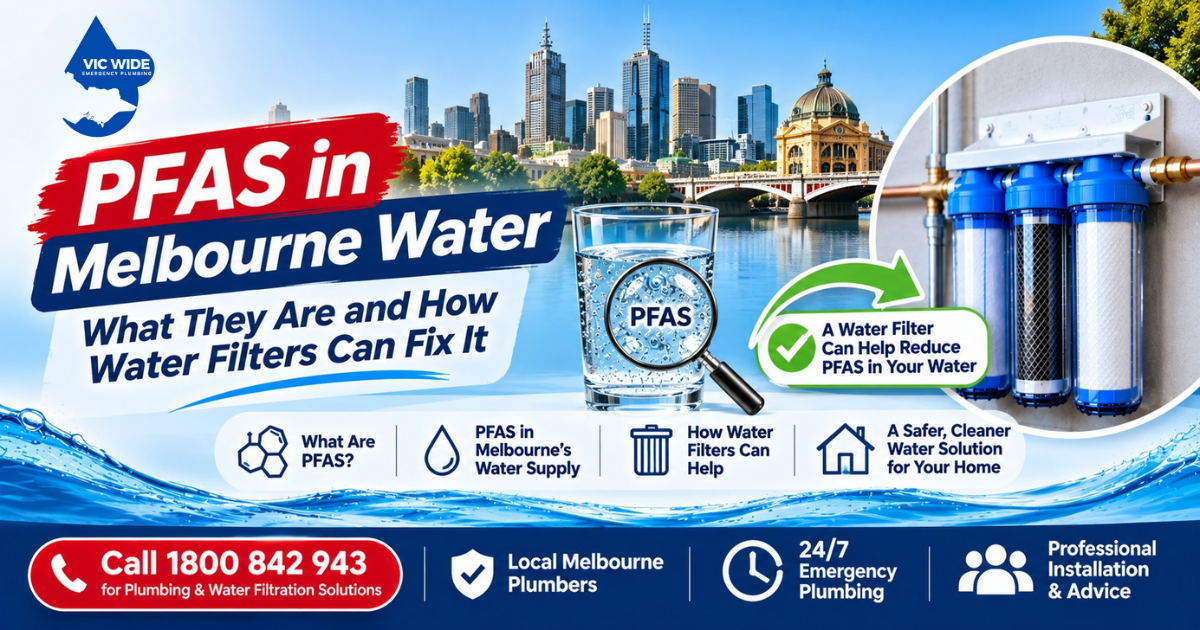
Water quality is an important concern for Australian households, and PFAS contamination has received increasing attention in recent years. Many Melbourne homeowners are now asking what PFAS chemicals are, how they can enter drinking water and whether household filtration systems can help reduce them.
PFAS stands for per- and polyfluoroalkyl substances. These are a large group of manufactured chemicals that have been used in products such as non-stick cookware, firefighting foams, food packaging and water-resistant fabrics.
They are often called forever chemicals because many PFAS compounds break down very slowly and can remain in the environment for extended periods.
Although not every Melbourne household is exposed to concerning levels of PFAS, understanding these chemicals and available water treatment options can help homeowners make informed decisions about their water quality.
In this guide, Vic Wide Emergency Plumbing explains what PFAS are, how they can enter water supplies, potential health concerns and which filtration technologies may help reduce their presence in drinking water.
Key Takeaways
- PFAS are a large group of synthetic chemicals used in various industrial and consumer products.
- Some PFAS compounds can persist in soil, groundwater and the environment for many years.
- Contamination can occur through industrial activities, firefighting foam use, landfill sites and other sources.
- Exposure to certain PFAS has been associated with potential health effects.
- Activated carbon and reverse osmosis systems can reduce certain PFAS when appropriately designed and tested.
- Not every water filter is capable of removing PFAS.
- Regular servicing and cartridge replacement are essential for maintaining filtration performance.
What Are PFAS Chemicals?
PFAS, or per- and polyfluoroalkyl substances, are a group of thousands of manufactured chemicals used in different products because of their resistance to heat, water, oil and stains.
These properties have made PFAS useful in several industries and everyday applications.
Common examples of products that have historically used PFAS include:
- Non-stick cookware
- Water-resistant clothing
- Stain-resistant carpets and furniture
- Food packaging materials
- Certain industrial coatings
- Some firefighting foams
The main concern is their environmental persistence. Many PFAS compounds do not break down easily, allowing them to remain in water, soil and other parts of the environment.
Some PFAS can also accumulate in the human body over time.
Why Is PFAS in Drinking Water a Concern?
PFAS contamination is a concern because people may be exposed to these chemicals through drinking water, food and other environmental sources.
Research has associated exposure to certain PFAS compounds with several potential health effects, including:
- Increased cholesterol levels
- Effects on the immune system
- Changes in liver function
- Hormonal and reproductive effects
- Developmental effects
- Increased risk of certain cancers
The potential health impact depends on the specific PFAS compound, the level of exposure and the length of time a person is exposed.
This does not mean that every water supply contains harmful PFAS concentrations. It is important to rely on water testing and official water-quality information rather than assuming contamination is present.
How Can PFAS Enter Melbourne’s Water Supply?
PFAS can enter the environment through several industrial and human activities.
Once released, these chemicals may move through soil and groundwater and potentially reach rivers, reservoirs and other water sources.
Some common sources include:
1. Firefighting Foam
Certain firefighting foams historically contained PFAS, particularly those used to extinguish fuel fires.
Areas where these products were used or stored may have experienced soil and groundwater contamination.
2. Industrial Activities
Some manufacturing and industrial processes have involved PFAS-containing materials.
Improper handling, storage or disposal can contribute to environmental contamination.
3. Landfill Sites
Products containing PFAS may end up in landfill facilities.
Over time, chemicals can enter landfill leachate and potentially migrate into surrounding soil or groundwater if not properly managed.
4. Contaminated Groundwater
PFAS can move through groundwater and affect nearby water sources.
This is particularly relevant when assessing properties that rely on private groundwater supplies rather than a public water network.
Does Melbourne Tap Water Contain PFAS?
PFAS levels can vary depending on the water source and location.
Melbourne’s public drinking water is treated and monitored by water authorities under applicable Australian drinking water requirements. However, homeowners who have specific concerns should consult current water-quality reports from their local water supplier.
Properties using private bore water or other independent supplies may require individual testing to understand their water quality.
A household water filter should not be installed simply on the assumption that PFAS is present. Testing and reliable water-quality information are the best starting points.
Can Regular Water Filters Remove PFAS?
Not all household water filters are designed to reduce PFAS.
Basic sediment filters, for example, are mainly intended to capture suspended particles such as dirt and rust. They generally do not remove dissolved PFAS compounds.
To reduce PFAS, homeowners should consider filtration technologies that have been independently tested for the specific compounds they want to remove.
Two commonly used technologies are activated carbon filtration and reverse osmosis.
1. Activated Carbon Filters
Activated carbon is widely used in drinking-water treatment because it can adsorb certain unwanted substances.
When water passes through activated carbon media, selected compounds attach to the carbon’s surface.
Depending on the filter design and performance testing, activated carbon systems can reduce certain PFAS compounds.
Carbon block filters may provide effective treatment when they have been specifically tested and certified for the relevant PFAS reduction claims.
Potential benefits include:
- Reduction of certain PFAS compounds
- Reduction of chlorine and associated taste and odour
- Convenient drinking-water filtration
- Availability in under-sink and other filter configurations
What to check: Confirm which PFAS compounds the product has been tested to reduce, its rated capacity and the recommended replacement interval.
2. Reverse Osmosis Water Filters
Reverse osmosis (RO) is another filtration technology that can help reduce PFAS in drinking water.
The system uses pressure to move water through a semi-permeable membrane. The membrane separates water from many dissolved substances and contaminants.
A properly designed reverse osmosis system can reduce certain PFAS compounds, depending on the membrane and the system’s independently verified performance.
Potential benefits include:
- Reduction of selected PFAS compounds
- Reduction of various dissolved contaminants
- Drinking-water treatment at a dedicated outlet
- Additional treatment stages when combined with suitable pre-filters and post-filters
Reverse osmosis systems are commonly installed under the kitchen sink.
What to check: Review the system’s PFAS testing results, membrane replacement requirements, water recovery rate and ongoing maintenance costs.
3. Whole House Water Filtration Systems
A whole house water filtration system is installed on the main incoming water supply.
Instead of treating water at one kitchen tap, it provides filtration to connected areas throughout the home.
Depending on its design, it may supply treated water to:
- Kitchen taps
- Bathroom taps
- Showers
- Laundry connections
- Washing machines
- Other connected fixtures
Some whole house systems use specialised activated carbon media designed to reduce particular PFAS compounds.
However, a standard whole house filter does not automatically remove PFAS. The system must be specifically tested and suitable for the compounds being targeted.
Potential benefits include:
- Filtration at the property’s main water entry point
- Treatment across multiple connected outlets
- Reduction of selected contaminants when supported by testing
- A centralised water treatment arrangement
Whole house filtration can be considered alongside an under-sink reverse osmosis system where additional drinking-water treatment is required.
However, the right combination depends on the water test results and household requirements.
Which Water Filter Should You Choose for PFAS Reduction?
Selecting a filtration system requires more than comparing prices or the number of filter stages.
Homeowners should check whether the product has been independently tested for the specific PFAS compounds they want to reduce.
Here are some important considerations.
| Filtration Type | Main Function | PFAS Reduction |
|---|---|---|
| Sediment filter | Captures suspended particles | Not generally designed for PFAS |
| Activated carbon filter | Adsorbs selected chemicals and compounds | Can reduce certain PFAS |
| Carbon block filter | Provides carbon-based filtration | Can reduce certain PFAS when tested |
| Reverse osmosis | Separates many dissolved substances through a membrane | Can reduce certain PFAS |
| Whole house filtration | Treats incoming water throughout the property | Depends on the installed filtration technology |
Before buying, look for independent performance testing, relevant certification and clear information about filter replacement.
Why Filter Maintenance Matters
Installing a suitable filtration system is only the first step. Ongoing maintenance is necessary to keep it working as intended.
Over time, filter media and membranes can lose effectiveness or become restricted by accumulated substances.
Important maintenance tasks include:
- Replacing cartridges according to manufacturer recommendations
- Checking the system for leaks
- Inspecting connections and filter housings
- Servicing reverse osmosis membranes when required
- Following the manufacturer’s maintenance schedule
- Checking system performance where appropriate
A filter that is overdue for replacement may not provide the performance claimed for a new cartridge.
For this reason, homeowners should keep maintenance records and use compatible replacement components.
Should Melbourne Homeowners Install a PFAS Water Filter?
Whether you need a PFAS-specific filtration system depends on your water source and the results of reliable water-quality information or testing.
If your property receives water from a public network, start by reviewing your supplier’s current water-quality information.
If you rely on private bore water, rainwater or another independent supply, consider arranging appropriate testing through a qualified laboratory.
If PFAS reduction is required, select a system with verified performance for the relevant PFAS compounds.
For homeowners considering whole house filtration, professional installation can also help ensure the system is correctly connected, has suitable water flow and can be maintained safely.
Final Thoughts: Can Water Filters Help Remove PFAS from Melbourne Water?
PFAS are persistent manufactured chemicals that have become an important environmental and water-quality concern.
Although not every Melbourne household is affected by PFAS contamination, understanding potential sources and treatment options can help homeowners make better decisions about their water supply.
Activated carbon and reverse osmosis technologies can reduce certain PFAS compounds when the systems are appropriately designed and independently tested. Whole house filtration may also be an option when the installed media has verified PFAS reduction performance.
The most important step is to identify your water-quality requirements before purchasing a filtration system. Not every filter removes PFAS, and no single system should be assumed to eliminate every contaminant.
At Vic Wide Emergency Plumbing, we understand the importance of reliable household plumbing and suitable water treatment solutions. If you are considering a water filtration installation or need assistance with your plumbing, contact our team to discuss your requirements.
Summary: Important Things to Know About PFAS in Water
- PFAS are manufactured chemicals used in many industrial and consumer products.
- They are often called forever chemicals because many compounds persist in the environment.
- PFAS can enter water through industrial activities, firefighting foam use, landfill sites and contaminated groundwater.
- Exposure to certain PFAS compounds has been associated with potential health effects.
- Melbourne homeowners should check official water-quality information rather than assume their tap water is contaminated.
- Activated carbon and reverse osmosis systems can reduce certain PFAS compounds.
- Whole house filtration can provide treatment throughout a property when suitable PFAS-tested media is used.
- Basic sediment filters are not designed to remove dissolved PFAS.
- Independent testing and regular filter maintenance are important for reliable performance.
Frequently Asked Questions
1. What does PFAS stand for?
PFAS stands for per- and polyfluoroalkyl substances. It is a large group of manufactured chemicals used in products such as non-stick cookware, water-resistant materials and certain firefighting foams.
2. Why are PFAS called forever chemicals?
Many PFAS compounds have strong chemical bonds and break down very slowly. As a result, they can remain in soil, water and the environment for extended periods.
3. Is Melbourne tap water contaminated with PFAS?
PFAS levels can vary by water source and location. Melbourne’s public drinking water is treated and monitored under applicable drinking water requirements. For current information, check the latest reports from your local water supplier.
4. Can you taste or smell PFAS in drinking water?
No. PFAS generally cannot be identified by taste, smell or appearance. Water testing is needed to determine whether particular PFAS compounds are present.
5. Can boiling water remove PFAS?
No. Ordinary boiling does not reliably remove PFAS from water. Because water evaporates while dissolved substances remain, boiling may actually increase their concentration in the remaining water.
6. Which water filters are effective against PFAS?
Certain activated carbon filters and reverse osmosis systems can reduce specific PFAS compounds. Choose products with independent testing or certification that supports their PFAS reduction claims.
7. Do whole house water filters remove PFAS?
Some whole house filtration systems are designed to reduce selected PFAS compounds. However, not every whole house filter provides this capability. Always check the system’s verified performance specifications.
8. Is a basic sediment filter enough to remove PFAS?
No. Sediment filters are primarily designed to capture suspended particles such as dirt and rust. They are not generally designed to remove dissolved PFAS chemicals.
9. How often should PFAS water filters be replaced?
Replacement intervals depend on the product, water quality and household usage. Follow the manufacturer’s instructions and use compatible replacement cartridges or membranes.
10. Should I test my water before installing a PFAS filter?
Yes. Testing or reviewing reliable water-quality information is an important first step. It helps establish whether PFAS treatment is necessary and which filtration technology is appropriate.
11. Can reverse osmosis remove all PFAS?
No system should be assumed to remove every PFAS compound completely. Reverse osmosis can reduce certain PFAS, but performance depends on the membrane, system design, operating conditions and independent test results.
12. Can I install a whole house water filtration system in an existing home?
Yes. Many existing homes can accommodate a whole house filtration system. The installation depends on the main water connection, available space, plumbing arrangement and system requirements.
Contact Vic Wide Emergency Plumbing
Want to discuss water filtration or need professional plumbing assistance?
Contact Vic Wide Emergency Plumbing for help with your household plumbing requirements.
Phone: 1800 842 943
Email: info@vicwideemergencyplumbing.com.au
Website: https://www.vicwideemergencyplumbing.com.au/
Service Area: Melbourne and surrounding suburbs
Emergency Plumbing: Available 24/7
-
 November Nov 2026Do Whole House Water Filters Increase Home Value?
When homeowners consider ways to improve their property, they often think about kitchen renovations, solar panels, energy-efficient appliances and bathroom upgrades. However, one improvement that is gaining attention is a whole house water filtration system. A whole house water filter can improve the quality of water supplied throughout a property, support household plumbing and make […]
Read More -
 November Nov 2026What Happens If You Drink Unfiltered Tap Water Every Day?
Water is an essential part of everyday life. Whether you are drinking a glass of water, preparing meals, making tea or coffee, or filling a bottle before leaving home, you probably use tap water several times a day. But have you ever wondered what is actually present in the water coming from your kitchen tap? […]
Read More -
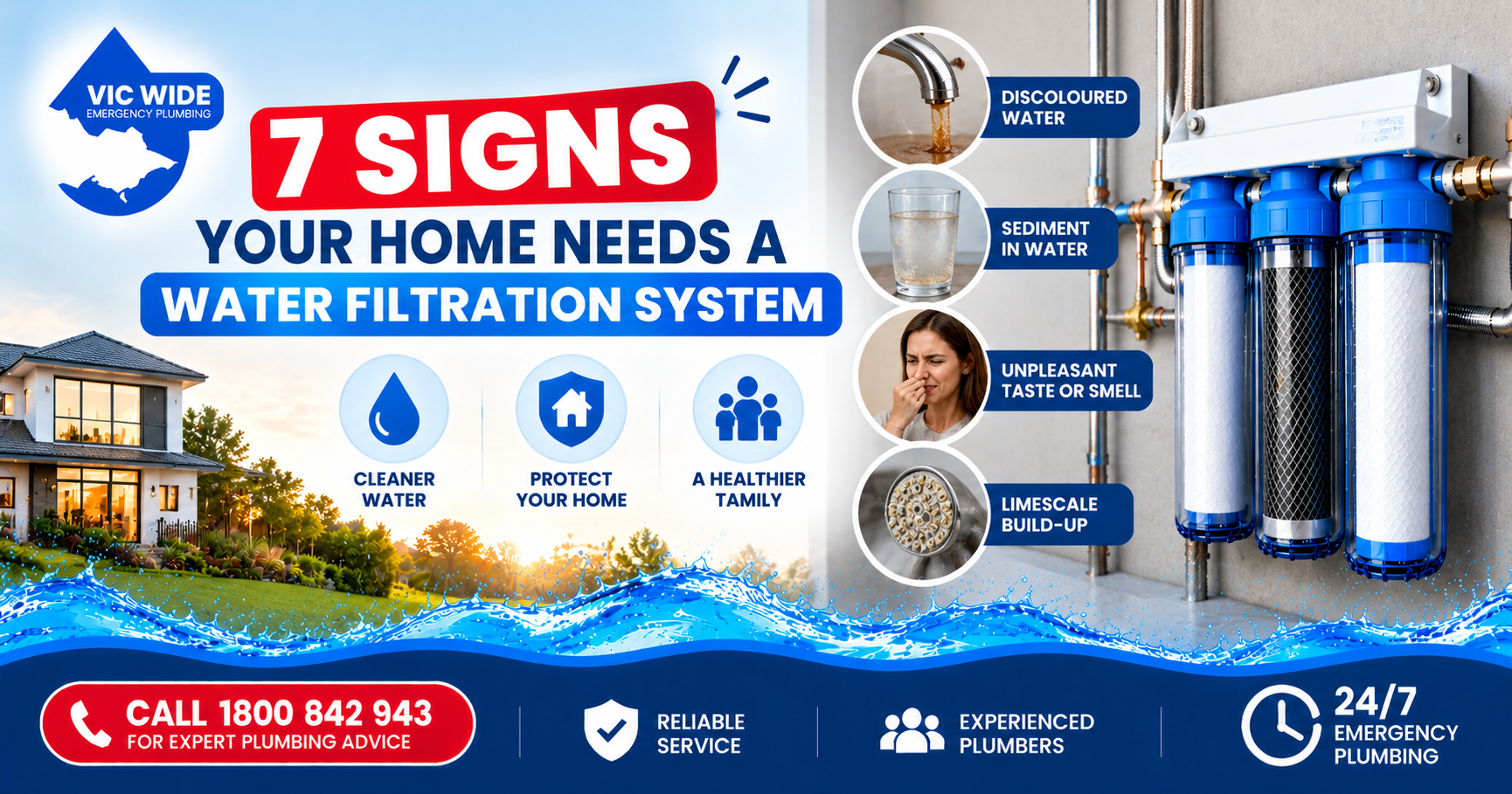 October Oct 20267 Signs Your Home Needs a Water Filtration System
Water is something we use every day, from drinking and cooking to showering, washing clothes and cleaning. While the water supplied to your property may meet applicable drinking water standards, its quality and characteristics can still vary depending on your location, plumbing condition and water source. Unusual tastes, unpleasant smells, visible particles and mineral deposits […]
Read More