



Clean drinking water is essential for everyday life. Whether you are preparing tea, cooking meals or filling a glass from the kitchen tap, you want water that is suitable for drinking and tastes fresh.
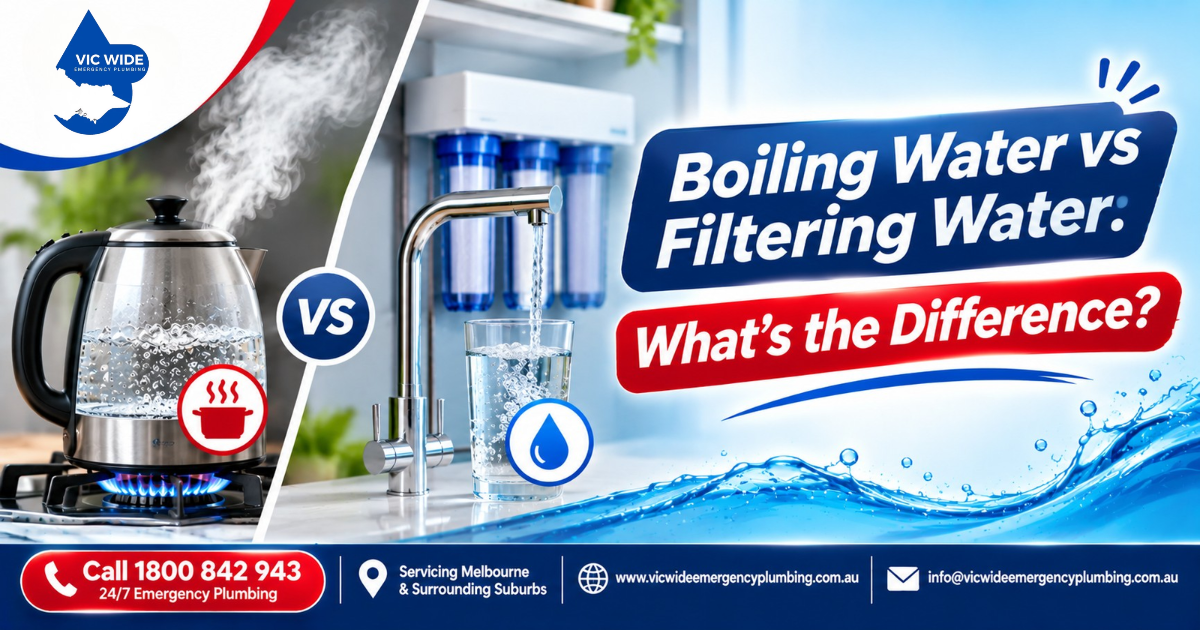
Two common ways of treating drinking water at home are boiling and filtration. Although both methods can improve certain aspects of water quality, they work in very different ways. Boiling uses heat to kill many harmful microorganisms, while water filtration uses specialised materials or membranes to reduce selected contaminants.
So, which option is better for your home? Let’s explore the differences between boiling water and filtering water, their advantages, limitations and what Melbourne homeowners should consider.
What Is the Difference Between Boiling Water and Filtering Water?
The main difference is how each method treats water.
Boiling water involves heating it to a rolling boil to inactivate many disease-causing microorganisms, including bacteria, viruses and parasites. It is commonly recommended as a temporary safety measure when drinking water may be microbiologically contaminated.
Filtering water involves passing water through a filtration system designed to reduce particular substances. Depending on the technology, a filter may reduce sediment, chlorine, certain chemicals, metals and other contaminants.
Neither method removes every possible contaminant. The right choice depends on the quality of your water and what you want to address.
1. How Does Boiling Water Work?
Boiling is one of the simplest ways to make water safer when microbial contamination is a concern.
When water reaches a rolling boil, heat inactivates many harmful microorganisms that can cause waterborne illnesses. Public health guidance commonly recommends bringing water to a rolling boil for one minute when a boil-water advisory is issued. At elevations above approximately 2,000 metres, the recommended boiling time is generally three minutes.
Benefits of Boiling Water
- Helps inactivate many bacteria, viruses and parasites.
- Requires only a suitable heating source and a clean container.
- Provides a temporary treatment option during certain water safety emergencies.
- Does not require a specialised filtration installation.
Limitations of Boiling Water
Boiling is not a complete water treatment solution. It has several important limitations:
- It does not reliably remove dissolved chemicals.
- It does not remove heavy metals such as lead.
- It does not reliably remove PFAS or other dissolved contaminants.
- It does not remove sediment or suspended particles.
- Evaporation can increase the concentration of certain substances left behind.
- Water needs to cool and be stored safely before drinking.
Boiling is therefore useful for addressing microbial risks, but it should not be considered a replacement for filtration when chemical or physical contaminants are the concern.
2. How Does Water Filtration Work?
Water filtration uses different technologies to improve water quality by reducing specific unwanted substances.
A filtration system may be installed at a single drinking-water outlet or where the main water supply enters the property.
The type of filtration technology determines what the system can remove or reduce.
Common Types of Water Filtration
Activated Carbon Filtration
Activated carbon uses a highly porous material to adsorb certain substances. It is commonly used to reduce chlorine, unpleasant tastes and odours. Some specially designed carbon filters can also reduce selected organic chemicals and PFAS compounds.
Sediment Filtration
Sediment filters capture suspended particles such as dirt, rust, sand and other visible impurities. They are often used as a first filtration stage to protect other components in a water treatment system.
Reverse Osmosis Filtration
Reverse osmosis uses a semi-permeable membrane to reduce many dissolved substances in water. Depending on the system, it can reduce certain salts, metals and selected chemical contaminants, including some PFAS compounds.
Whole House Water Filtration
A whole-house filtration system is installed at the property’s main water entry point. It treats incoming water before it reaches different taps, showers and other plumbing outlets.
The filtration stages should be selected according to the water quality and the contaminants the system is intended to reduce.
3. Boiling Water vs Filtering Water: Key Differences
| Comparison | Boiling Water | Filtering Water |
|---|---|---|
| Main purpose | Inactivates many harmful microorganisms | Reduces selected contaminants |
| Bacteria and viruses | Effective against many when properly boiled | Depends on filter technology |
| Sediment | Does not remove it | Suitable sediment filters can capture it |
| Chlorine | Does not reliably remove it | Suitable activated carbon filters can reduce it |
| Heavy metals | Does not remove them | Certain specialised systems can reduce them |
| PFAS | Does not reliably remove them | Certain tested carbon and RO systems can reduce selected compounds |
| Ongoing use | Requires heating each time | Depends on the installed system and maintenance |
The important point is that boiling and filtering serve different purposes. A filtration system should always be selected according to its independently verified performance rather than assuming that every filter removes every contaminant.
4. Which Option Is Better for Drinking Water?
There is no single answer for every household.
If the concern is harmful microorganisms, boiling can be an effective temporary treatment when carried out correctly.
If the concern is chlorine taste, sediment or particular dissolved contaminants, an appropriately selected filtration system may be more suitable.
In some situations, both methods may be needed. For example, if an official boil-water advisory is in place, boiling instructions should still be followed even if the property has a standard water filter. Not all filtration systems are designed to remove or inactivate microorganisms.
For Melbourne households using mains water, it is worth reviewing the local water supplier’s quality information before deciding whether additional treatment is necessary.
5. Can Water Filters Make Tap Water Taste Better?
Yes, certain water filters can improve the taste and smell of drinking water.
Chlorine is commonly used during drinking water treatment to help maintain water safety. However, some people notice its taste or odour in their tap water.
Activated carbon filters can reduce chlorine and certain compounds responsible for unpleasant tastes and smells.
The result depends on the filter’s design, water conditions and maintenance. Filter cartridges also need to be replaced at the recommended intervals to maintain their performance.
6. Is Boiled Water Safer Than Filtered Water?
It depends on the type of contamination.
Boiling is useful for inactivating many microorganisms, but it does not remove dissolved chemicals, metals or other substances that may be present in water.
Filtration can reduce selected contaminants, but a standard household filter may not provide adequate protection against microorganisms.
For this reason, it is important to understand the specific water-quality issue before choosing a treatment method.
If authorities issue a boil-water advisory, follow their instructions even if you already have a filtration system installed.
7. Should You Install a Water Filtration System at Home?
A home water filtration system may be worth considering if you want to address specific water-quality concerns.
Some common reasons homeowners explore filtration include:
- Unpleasant chlorine taste or odour.
- Sediment or visible particles in water.
- Concerns about particular contaminants.
- A preference for filtered drinking water.
- Water-quality issues identified through testing.
- Treatment requirements for private bore or rainwater supplies.
Before purchasing a system, consider having your water tested where appropriate. This helps identify the substances that need attention and makes it easier to choose suitable filtration technology.
8. How to Choose the Right Water Filtration System
Choosing a filtration system requires more than comparing brands and prices. Consider the following factors before making a decision.
Identify Your Water Source: Determine whether your home receives mains water, bore water or rainwater.
Understand Your Water Quality: Testing can help identify specific contaminants and establish whether additional treatment is required.
Select the Correct Technology: Different filtration systems are designed for different purposes. Choose one that has verified performance for the substances you want to reduce.
Consider Installation Requirements: Decide whether you need filtration at one drinking-water tap or throughout your home.
Check Maintenance Costs: Include cartridge replacements, membrane changes and servicing when comparing systems.
Use Qualified Installation Support: Correct plumbing connections and installation help the system operate as intended.
9. Why Is Regular Water Filter Maintenance Important?
Installing a filtration system is only the beginning. Regular maintenance is essential for keeping it in good working condition.
As water passes through a filter, particles and other substances can accumulate in the filtration media. Over time, this can affect water flow and treatment performance.
Basic maintenance includes:
- Replacing filter cartridges according to the manufacturer’s instructions.
- Checking connections for leaks.
- Inspecting the system for visible damage.
- Following the recommended servicing schedule.
- Replacing reverse osmosis membranes when required.
A neglected filter may not perform as expected, so it is important not to overlook routine maintenance.
Final Thoughts
Boiling water and filtering water are two different approaches to improving drinking water quality. Boiling helps inactivate many harmful microorganisms, making it useful when microbial contamination is a concern. Filtration systems, on the other hand, can reduce selected particles, chemicals and dissolved substances depending on their technology.
Neither method is a universal solution. The best option depends on your water source, the contaminants you want to address and the performance of the treatment system.
If you are considering a water filtration system for your Melbourne property, Vic Wide Emergency Plumbing can help you explore suitable plumbing and filtration installation options.
Frequently Asked Questions
1. Is boiled water better than filtered water?
Not necessarily. Boiling is effective against many harmful microorganisms, while filtration can reduce selected contaminants. The better option depends on the water-quality concern.
2. Does boiling water remove chlorine?
Boiling may reduce some free chlorine under certain conditions, but it is not a reliable or comprehensive method of removing chemical contaminants.
3. Does boiling water remove heavy metals?
No. Boiling does not remove dissolved heavy metals. Evaporation can potentially increase their concentration in the remaining water.
4. Can water filters remove bacteria?
Some specialised filtration systems can reduce bacteria, but this depends on their design and certification. Standard carbon filters should not automatically be considered microbiological treatment systems.
5. Does a water filter remove chlorine?
Many activated carbon filters are designed to reduce chlorine and improve the taste and odour of drinking water.
6. Can water filters remove PFAS?
Certain activated carbon and reverse osmosis systems can reduce selected PFAS compounds. Always check independent product testing and performance specifications.
7. Is it necessary to boil filtered water?
Not under normal circumstances if the water is already safe and the filtration system is suitable for its intended purpose. However, follow official boil-water advisories regardless of whether you have a standard filter.
8. How often should water filters be replaced?
Replacement intervals vary according to the filter type, water quality and household usage. Follow the manufacturer’s recommended schedule.
9. What is the difference between a whole-house filter and an under-sink filter?
A whole-house filter treats incoming water for multiple outlets across the property. An under-sink filter generally treats water supplied to a specific drinking-water tap.
10. Can a plumber install a whole-house water filtration system?
Yes. A qualified plumber can assess your plumbing layout, identify suitable installation points and connect a compatible filtration system.
Contact Vic Wide Emergency Plumbing
Looking for professional plumbing assistance or water filtration installation in Melbourne?
Vic Wide Emergency Plumbing
- Phone: 1800 842 943
- Email: info@vicwideemergencyplumbing.com.au
- Website: https://www.vicwideemergencyplumbing.com.au/
Providing plumbing services across Melbourne and surrounding suburbs, with 24/7 emergency plumbing support.
-
 November Nov 2026PFAS in Melbourne Water, What They Are and How Water Filters Can Fix It
Water quality is an important concern for Australian households, and PFAS contamination has received increasing attention in recent years. Many Melbourne homeowners are now asking what PFAS chemicals are, how they can enter drinking water and whether household filtration systems can help reduce them. PFAS stands for per- and polyfluoroalkyl substances. These are a large […]
Read More -
 November Nov 2026Do Whole House Water Filters Increase Home Value?
When homeowners consider ways to improve their property, they often think about kitchen renovations, solar panels, energy-efficient appliances and bathroom upgrades. However, one improvement that is gaining attention is a whole house water filtration system. A whole house water filter can improve the quality of water supplied throughout a property, support household plumbing and make […]
Read More -
 November Nov 2026What Happens If You Drink Unfiltered Tap Water Every Day?
Water is an essential part of everyday life. Whether you are drinking a glass of water, preparing meals, making tea or coffee, or filling a bottle before leaving home, you probably use tap water several times a day. But have you ever wondered what is actually present in the water coming from your kitchen tap? […]
Read More